
The Land Changes Hands: The Lenni-Lenape Deed the Hopewell Area to the English
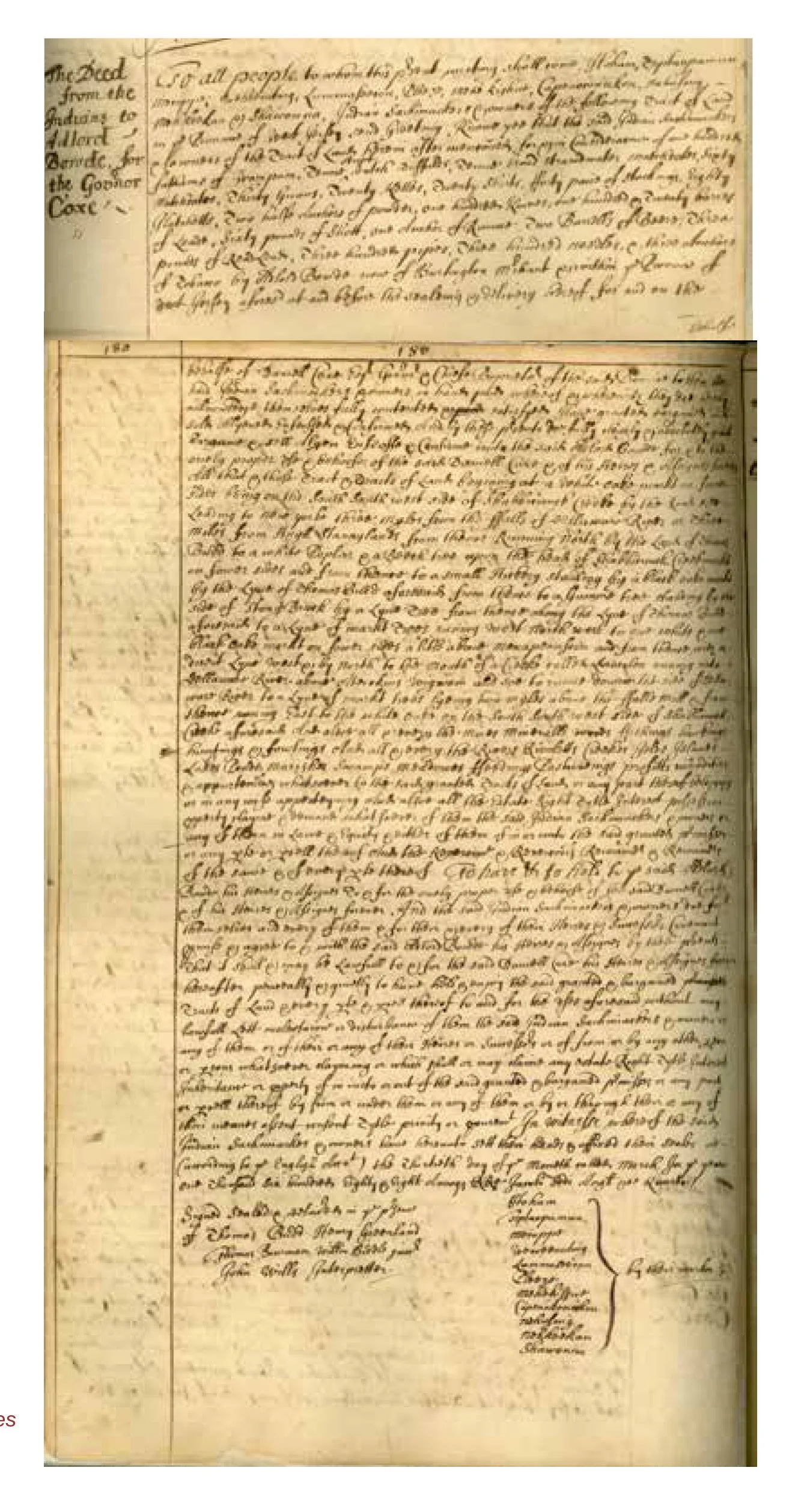
1688: Lenape indians deed hopewell area to the english. New Jersey State Archives, Department of State. Deeds WJ Book B, pages 179–181 V03-04-08.
The Lenni-Lenape people occupied the region of the Hopewell Valley for thousands of years before the arrival of English colonists. On 30th March 1688, eleven “Sachimackers” (negotiators appointed by the Lenni-Lenape Indians) put their names to a deed. In the minds of the English settlers, the Indians had sold the area which is now Hopewell and Ewing Townships to Daniel Coxe, Governor of the English colony of West New Jersey. The items that were given to the Lenape as “consideration” or, the negotiated benefit given in return for the land, provide a clue to the size of the area community. (“Twenty kettles,” likely iron or bronze cauldrons, suggest about twenty households or wigwams.) The items were worth approximately 110 English pounds. (You could purchase a house in Perth Amboy, New Jersey, for five pounds in the 1680s.)
A transcription of the original document, held in the New Jersey State Archives follows.
(30th March 1688)
Deed from the Indians to Adlord Bowde, for the Govnor Coxe
Eleven Indian “Sachimackers” (negotiators appointed by the Indians) identify themselves
1. To all people to whom this present writing shall come, Hoham, Teptaopamun
2. Mecoppe, Weheenoting, Lummaseecon, Pleeze, Mehekishue, Capenoconickon, Nahusing
3. Mehkeekan & Shawonna, Indian Sachimackers & owners of this following tract of land
4. in the Province of West Jersey, send greeting.
The consideration or payment for the land is specified
Know yee that the said Indian Sachimackers
5. & owners of the Tract of Lands hereinafter mentioned, for and in consideration of one hundred 6. fathoms of wampum, Tenne stript (probably “striped”), Dutch duffelds (heavy coarse wool blankets from what is now Belgium), Tenne broad stroudwater matchcotes, sixty
7. matchcotes, thirty guns, twenty kettles, twenty shirts, fforty paire of stockings, eighty
8. Hatchetts, two half anchors of powder, one hundred knives, one hundred and twenty barres
9. of lead, sixty pounds of shott, one anchor of rumme, two barrels of beere, three
10. pounds of Read Lead, three hundred pipes, three hundred needles, & three anchors
11. of tobacco
Payment is made by the Burlington Merchant Adlord Bowde for Daniel Coxe, Governor of West Jersey
by Adlord Bowde now of Burlington Merchant & within ye province of
12. West Jersey aforesaid at and before the sealing & delivery thereof for and on the
13. behalf of Daniel Coxe Esq Governor and Chief Proprietor of the said province to them the
14. said Indian Sachinackers and owners
The Sachimackers acknowledge receipt of the payment, and agree that they have granted and sold the land to Adlord Bowde for Daniel Coxe
in hand paid whereof and wherewith they doe hereby
15. acknowledge themselves fully contented & satisfied, have granted bargained and
16. sold Alyened, (i.e. aliened enfeoffed & confirmed and by these presents do fully clearly & absolutely grant
17. bargaine and sell, Alyen, enfeoff and confirm unto the said Adlord Bowde for & to the
18. only proper use & behoofe of the said Daniel Coxe & of his heirs & assigns forever
The boundaries of the sold land are described
19. All that & those tract & tracts of land beginning at a white oak markt on fower
20. sides being on the south south west side of Shabbicunck Creeke by the road side
21. leading to New York three myles from the ffalls of Delaware River or three
22. from Hugh Stannylands from thence running north by the Land of Thomas
23. Budd for a white poplar & a Beech tree upon the head] of Shabbicunck Creek markt
24. on fower sides and from thence to a small Hickery standing by a black oake markt
25. by the line of Thomas Budd aforesaid from thence to a gumme tree standing by the
26. side of Stony Bruck by a Lyne tree from thence along the line of Thomas Budd
27. aforesaid to a line of markt trees running west northwest to one white & one
28. black oake markt on fower sides a little above Menapenascon and from thence with a
29. direct lyne west & by north to the mouth of a creek called Laocolon, running into
30. Dellaware River about Atecoking [or Atercokings] wigwam and soe to runne down the side of Della-
31. ware River to a line of markt trees lying two myles above the ffalls mill (presumably the mill recently built by Mahlon Stacy on the Assunpink Creek at the “Falls of the Delaware”) & from
32. thence running east to the white oake on the south south west side of Shabbicunck
33. Creek aforesaid
The important resources within the tract are listed as part of the sale
And also all & every the mines minerals woods ffishings hawkings
34. huntings & fowlings And all and every the rivers Rivoletts creeks isles islands
35. lakes ponds marishes swamps meadows Feedings Pastureings profitts commodities
36. & appurtenances whatsoever to the said granted Tracts of land or any part therof belonging
37. or in any wise apperteyning
Any legal rights or value associated with the land are also transferred to the new owner
And also all the Estate Right title interest possession
38. pperty clayme & demand whatsoever of them the said Indian Sachimackers & owners or
39. any of them in law & equity & either of them of in or unto the said granted prmisses
40. or any pte or pcell thereof And the Revercone & Revercons Remaindr & Remaindrs]
41. of the same & of every pte thereof.
Confirmation of transfer of the land, and renunciation of all claims by the Indians
To have and to hold for the said Adlord
42. Bowde his heirs & assigns To & for the only proper use & behoof of the said Daniell Coxe
43. & of his heirs & assigns forever. And the said Indian Sachimackers and owners do for
44. themselves and every of them & for their & every of their heirs & successors covenant
45. pmise and agree to and with the said Adlord Bowde his heirs & assigns by these presents
46. that it shall and may be lawfull to and for the said Daniell Coxe & his heirs & assigns forever
47. hereafter peaceably & quietly to have hold & enjoy the said granted & bargained (crossed out)
48. Tracts of land & every pte & pcell therof to and for the uses aforesaid without any
49. lawfull let Lett, molestation or disturbance of them the said Indian Sachimackers & owners or
50. any of them or of their or any of their heirs and successors or of from or by any other person
51 or persons whatsoever clayming or which shall or may claime any estate right Tytle interest
52. Inheritance or property of in unto or out of the said granted & bargained premises or any part
53. or parts pcell therof by from or under them or any of them or by or through their or any of
54. their meanes assent consent Tytle privity or pcuremt.
Statement of signing and witnessing, with date (March 30th 1688 in the fourth year of the reign of King James the Second)
In witness whereof the said
55. Indian Sachimackes & owners have hereunto sett their hands & affixed their seals ~
56. (according to the English Accot) the thirtieth day of ye month called March in ye yeare
57. one thousand six hundred eighty eight Annoqs Rg Jacobi sedi (abbreviation for secundi [second]). Angli &c quarto.
Four English witnesses and an Interpreter
Signed sealed and delivered in ye presence
of Thomas Budd Henry Greenland
Thomas Bowman William Biddle junr
John Wills Interpreter
The Sachimackers’ Names re-stated as signatories
Hoham
Teptaopamun
Mecoppe
? Weweenoting
? Lummaseecon
? Pleeze by their marks
? Mehekissue
Capenokonickon
? Nehusing
Nehkeekan
Shawonna
In Exchange for the Land
The items listed in the deed that were given to the Indians as “consideration”, or the negotiated benefit given in return for the land are explained below. The approximate monetary value of these items in 1688 was about 110 English pounds. To give some idea of the buying power of this amount, you could buy about 30 cows with it. You could buy a house in Perth Amboy, New Jersey, for five pounds in the 1680s. The cost of Hopewell to Daniel Coxe was about one penny per acre (240 pennies = one English pound).
“ONE HUNDRED FATHOMS OF WAMPUM”
“Wampum” refers to white and purple tubular shell beads made by Indians of New England and widely used for trade and for ceremonial uses at this time (1911 Encyclopedia Britannica, “Wampum”).
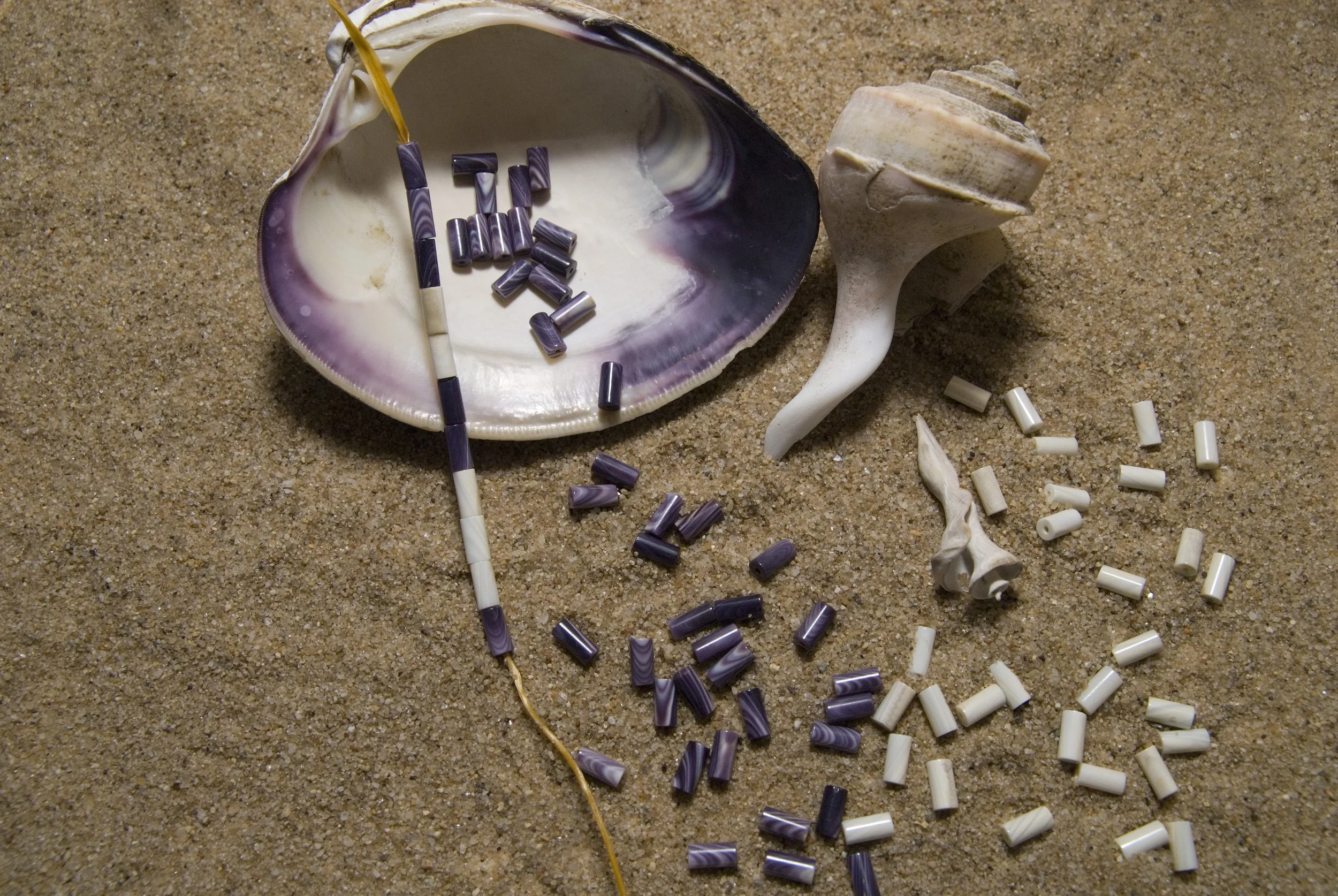
Wampum beads and the shells typically used to make them.
A fathom was a measure of 240 strung beads of wampum and may have been usually six feet long (one fathom) worth about 5 shillings per fathom at the time. 100 fathoms were therefore worth 500 shillings. At 20 shillings to the pound, this comes to 25 English pounds.
Why did the Indians want this?
Wampum had both a monetary value and a symbolic meaning. Belts made of wampum were often exchanged as part of treaties or agreements. Wampum as the first item on the list and this probably reflects this importance.
“TENNE (10) STRIPT (STRIPED) DUTCH DUFFELDS”
These were coarse heavy blankets made in what is now Belgium
Why did the Indians want this?
Blankets were very versatile. They could be used as bedding and as clothing. They could also be cut up into smaller pieces for a variety of purposes. They could be unwoven to use the thread.
“TENNE BROAD STROUDWATER MATCHCOTES”
These are either blankets, or tailored woolen coats with sleeves, pockets and buttons. The word “matchcoat” originally referred to European-made units of woolen cloth, generally about two meters (a ‘‘fathom’’) long, that were traded to natives who wore them as loosely wrapped
Cloaks (Ref Becker). By the 1680’s the word was also used for tailored woolen coats.
“Stroudwater” refers to the cloth producing area in and around Stroud in Gloucestershire, England.
“SIXTY MATCHCOTES”
See above. These were probably ordinary blankets rather than coats.
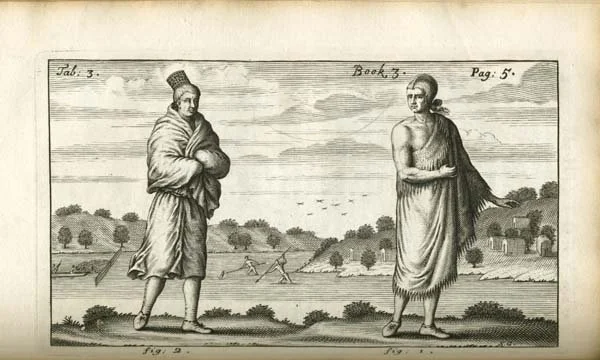
IMAGE OF AN INDIAN MAN OF THE LATE 1600’S WEARING A TRADE BLANKET IN THE STYLE OF A MATCHCOAT
“THIRTY GUNS”
These were probably smoothbore flintlock muskets, very likely made in England for trade with the Indians.

Why did the Indians want this?
The Indians recognized very quickly that firearms were in many ways more effective that traditional bows and arrows or spears. They were used both for hunting and in warfare.
“TWENTY KETTLES”
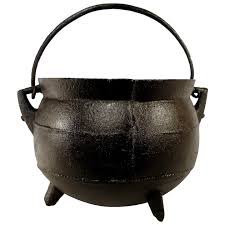
Cast-iron cauldrons with three legs and two handles. These varied in size from half a gallon to ten gallons. These cooking pots are “female” artifacts and may give us some idea of the number of households involved in the transaction, if we assume one kettle per household.
Why did the Indians want this?
Kettles had come to replace large traditional cooking pots made of fired clay. They were durable, and could be set directly in a cooking fire or suspended over it. Lenape cooking included the making of stews of meat and vegetables for many people at a time. If a kettle was broken, the iron could be used for other purposes. Some kettles were of brass, and these were often intentional broken up to make arrowheads, ornaments and tools.
“TWENTY SHIRTS”
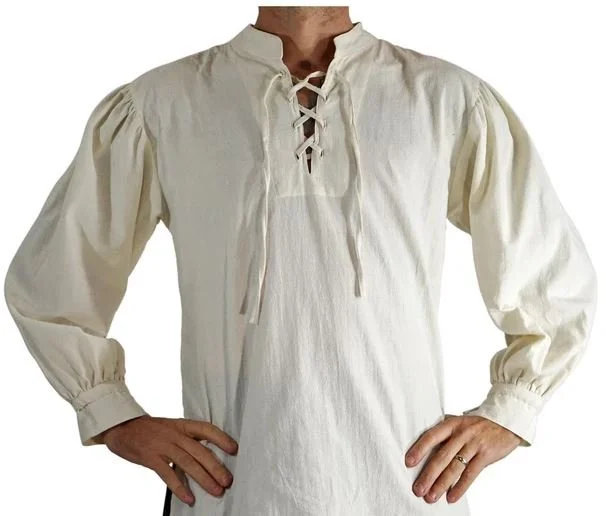
These were probably long-sleeved mens’ shirts of linen.
Why did the Indians want this?
European clothing had become popular among the Indians.
“FFORTY (40) PAIRE OF STOCKINGS”
Probably knitted of fine and strong worsted wool. They might be knee-length or full-length.
Why did the Indians want this?
Traditional Indian clothing included the wearing of leggings made of Buckskin, and so European stockings fitted into the clothing patterns that Indian people were already used to.
“EIGHTY HATCHETTS”
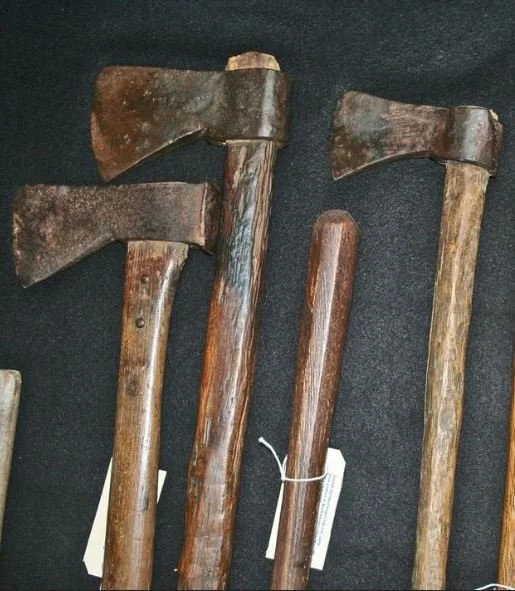
Hatchets are small axes with short straight handles for use in one hand. Probably considered “tomahawks” by the Indians.
Why did the Indians want this?
These were versatile multi-purpose tools and weapons If the handle broke it was easy to make a new one.
“TWO HALF ANCHORS (ANKERS) OF (GUN) POWDER”
An anker is a cask holding about ten gallons
“ONE HUNDRED KNIVES”
Iron knives had largley replaced traditional Indian knives of stone or bone
“ONE HUNDRED AND TWENTY BARRES OF LEAD”
Could be melted down and poured into bullet molds
“SIXTY POUNDS OF SHOTT”
Musket balls and possibly also smaller buckshot and birdshot
“ONE ANCHOR (ANKER) OF RUMME” (about 10 gallons)
“TWO BARRELS OF BEERE”
A barrel is a cask holding 36 gallons, so 72 gallons total.
“THREE POUNDS OF READ (RED) LEAD”
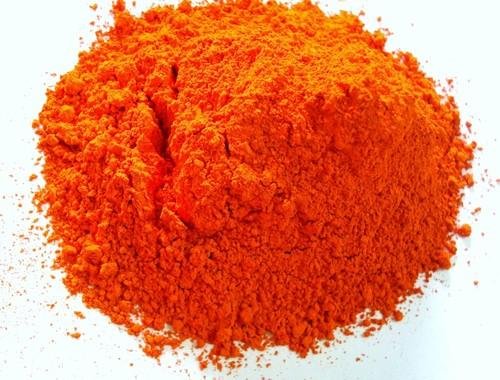
This is lead oxide powder. It was widely used by Native Americans for making body paint by mixing it with water or fat.
“THREE HUNDRED PIPES”
Tobacco smoking pipes made of white clay.
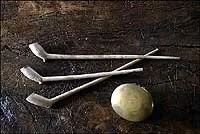
Why did the Indians want this?
Indians had been smoking tobacco in clay pipes for several hundred years before Europeans arrived. By the late 1600’s pipes like these were being made in large quantities in England, Holland and elsewhere. They were cheap and worked well. Smoking was both a recreational and a spiritual practice for the Indians.
“THREE HUNDRED NEEDLES”
For sewing.
“THREE ANCHORS OF TOBACCO”
Three 10-gallon casks.
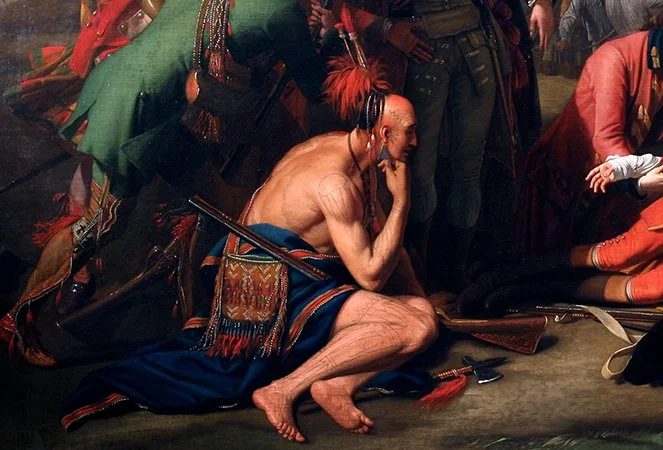
This Indian warrior (a detail from The Death of General Wolf by Benjamin West, 1770, National Gallery of Canada) has many of the items obtained in trade with Europeans, items very similar to those listed in the 1688 treaty. These include:
Striped blanket/matchcoat
Hatchet/tomahawk
Musket
Red paint
Questions to Consider
The eleven Indian leaders were probably negotiating on behalf of their community, not just for themselves. Are there any clues as to how many people there were in total? Clue: number of guns (gender?), versus number of kettles (gender?).
Why did the Indians sell the land?
What rights did the English think they had obtained by this transaction?
What rights did the Indians think they retained by this transaction?